Filters for a Hot Tub: Maintenance Tips for Clean, Clear Water
When it comes to keeping your spa

Cloudy hot tub water usually means that fine particles, oils, microorganisms or treatment products are remaining suspended in the water instead of being removed or controlled properly.
The cause may be relatively simple, such as a dirty filter, heavy recent use or an incorrect pH level. In other cases, persistent cloudiness can indicate a circulation problem, worn filtration equipment or water that has become too difficult to balance effectively.
Clear water is not the only sign of a well-maintained hot tub, but visible cloudiness should never be ignored. It suggests that the filtration and treatment process is not working as intended, and the water should not simply be used until it looks better on its own.
The safest approach is to stop using the hot tub temporarily, test the water and work through the possible causes in a logical order. Adding several chemicals without testing first may make the problem more difficult to identify and can create additional water-balance issues.
What does cloudy hot tub water look like?
Cloudy water can vary from a slight haze to water that is so opaque that the footwell or lower seats are difficult to see.
A minor loss of clarity may be noticeable only when the hot tub lights are switched on. More severe cloudiness can make the water appear grey, milky or dull even in daylight.
The appearance can provide clues, but it cannot identify the cause by itself.
Slightly hazy water
A faint haze often develops after several people have used the hot tub, particularly if they entered wearing moisturiser, make-up, fake tan or hair products.
It may also appear when the filter is due for cleaning or when water balance has started to move outside the recommended range.
Although the problem may seem minor, it should still be checked before the next bathing session.
Milky or grey water
Milky water can occur when very fine particles remain suspended in the water. This may be linked to poor filtration, incorrect chemical balance, dissolved contaminants or treatment products reacting with substances already present.
The water may also develop this appearance after excessive chemical use.
Adding more sanitiser is not always the correct response. Testing should come first.
Water with floating debris
Visible particles, foam or material collecting around the waterline suggest that the filtration system is struggling to remove contaminants.
Leaves and garden debris may be obvious, but many pollutants are introduced by bathers. Perspiration, body oils, cosmetics, detergents from swimwear and traces of household products can all affect water quality.
What are the most common causes of cloudy hot tub water?
Cloudy water rarely has just one possible explanation. Several issues may occur at the same time, particularly when routine maintenance has been delayed.
The most common causes include:
A systematic check is more effective than guessing.
Can low sanitiser levels make the water cloudy?
Yes. Sanitiser helps control microorganisms and break down contaminants introduced into the water.
When the sanitiser level becomes too low, the water may lose clarity as the system struggles to manage organic material and microbial growth.
This does not mean that every cloudy hot tub simply needs more chlorine or bromine. A reading may appear low because the sanitiser is being consumed rapidly by a high contaminant load, or because the wider water balance is preventing it from working effectively.
Heavy use can consume sanitiser quickly
Two people using a small hot tub can introduce a significant amount of organic material into a relatively limited volume of water.
The effect can be greater after:
After heavier use, the sanitiser demand may rise quickly. Water that appeared balanced earlier in the day may require attention later.
Test before adding treatment
Use a suitable water-testing method and compare the result with the range recommended for the hot tub and chosen treatment system.
If the reading is outside the required range, make adjustments according to the product instructions. Avoid estimating quantities by eye.
Too little treatment may leave the water inadequately sanitised, while too much can cause discomfort, damage components and create its own water-quality problems.
How do pH and alkalinity affect water clarity?
The pH level influences how comfortable the water feels, how effectively certain sanitisers work and how the water interacts with the hot tub’s components.
Total alkalinity helps resist sudden changes in pH. When alkalinity is poorly controlled, the pH may move unpredictably and become difficult to maintain.
Incorrect pH can contribute to cloudy water and may also lead to scale, corrosion or irritation.
High pH can create haze and scale
When pH is too high, dissolved minerals may become more likely to form deposits or remain visible in the water.
The water may appear dull or cloudy, and rough scale may begin to develop around jets, heaters or the waterline.
High pH can also reduce the effectiveness of some sanitising systems, allowing other water-quality problems to develop.
Low pH can damage the hot tub
Low pH does not always cause obvious cloudiness, but it can make the water corrosive.
Over time, acidic water may affect seals, heaters, metal components and other equipment. It may also irritate the skin and eyes.
Water balance should therefore be corrected even when the water still looks clear.
Adjust alkalinity in the correct order
When both alkalinity and pH are outside the recommended ranges, alkalinity is often addressed first because it affects pH stability.
Follow the specific instructions for the products and treatment system in use. Chemical products should be added separately and given time to circulate where instructed.
Never mix concentrated hot tub chemicals together.
Can a dirty filter cause cloudy water?
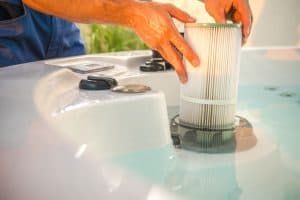
A dirty filter is one of the most common causes of poor water clarity.
The filter is responsible for trapping particles as water circulates through the system. Over time, its pleats collect oils, debris and fine material.
When the filter becomes clogged, less water may pass through effectively. Particles remain suspended, circulation can weaken and the equipment may have to work harder.
Visual appearance is not enough
A filter may appear reasonably clean on the outside while material remains trapped deep within the pleats.
Remove the filter according to the manufacturer’s instructions and inspect it carefully. Spread the pleats gently and look for discolouration, grease, scale or damaged material.
A quick rinse may remove loose debris but may not deal with oils or deeply embedded contamination.
Clean the filter properly
Routine filter care may include:
Do not use ordinary washing-up liquid or household cleaners. These may leave residues that cause foam and further water-quality problems.
Filters eventually need replacing
Cleaning cannot restore a filter indefinitely.
Pleats may become worn, damaged or permanently blocked. The filter material may also lose its ability to trap contaminants effectively.
Replacement frequency depends on the filter type, usage level and maintenance routine. Follow the manufacturer’s guidance and replace the filter sooner if it is damaged or no longer cleans properly.
How does poor circulation make hot tub water cloudy?
The treatment and filtration system depends on water moving through the hot tub.
If circulation is weak or interrupted, sanitiser may not be distributed evenly and suspended particles may not reach the filter.
Possible circulation issues include:
Some causes can be checked by the owner, while others require professional diagnosis.
Check the water level
If the water level is too low, the system may draw in air rather than circulating water correctly.
Top up the hot tub to the level specified by the manufacturer. Do not overfill it, as the water level will rise when people enter.
A falling level may also indicate a leak, particularly when regular topping up becomes necessary.
Look at the water movement
When the circulation system is operating, there should normally be visible or detectable water movement through the relevant outlets.
A noticeable reduction may suggest a blocked filter or equipment issue.
Do not remove panels or interfere with electrical components unless you are qualified and authorised to do so. Hot tubs combine water and electrical equipment, so unsafe investigation creates serious risks.
Can body oils and cosmetics make the water cloudy?
Yes. Many cases of cloudy water are linked to contaminants introduced by users rather than a fault with the hot tub.
Common sources include:
These substances add to the amount of material that the sanitiser and filter must manage.
Showering first can reduce contamination
A quick shower before entering can remove a significant amount of cosmetic product and perspiration.
This is particularly useful when several people will use the hot tub or when bathers have recently applied sun cream or body lotion.
Guests and family members should also be encouraged to use swimwear that has been rinsed thoroughly without fabric conditioner.
Foam can appear alongside cloudiness
Detergents and body-care products may cause persistent foam when the jets are operating.
A small amount of temporary bubbling is not necessarily unusual, but thick foam that remains on the surface often indicates a build-up of contaminants.
Anti-foam products may suppress the visible symptom temporarily, but they do not remove the underlying cause.
The water, filters and bathing habits should be reviewed.
Can old hot tub water become difficult to maintain?
Yes. Hot tub water accumulates dissolved materials over time, even when regular testing and treatment are completed.
Each dose of treatment product adds material to the water. Bathers also introduce contaminants, while topping up replaces evaporated water without removing everything left behind.
Eventually, the water may become difficult to balance and lose clarity repeatedly.
Water cannot be maintained forever
Filtration removes particles, but it does not remove every dissolved substance.
When the water has reached the end of its useful period, adding more products may provide only temporary improvement.
Signs that a complete water change may be needed include:
The appropriate interval depends on the hot tub, usage and treatment system.
Follow the correct draining process
Before draining, check the manufacturer’s instructions and consider where the treated water will go.
The hot tub may also benefit from an approved pipe-cleaning or system-flushing product before the old water is removed. This can help address material within the plumbing that ordinary surface cleaning cannot reach.
After draining:
Avoid using household cleaning products unless they are specifically approved for hot tub surfaces.
Can adding too many chemicals cause cloudy water?
Yes. Over-treatment can make the water cloudy and create an unstable chemical balance.
Owners sometimes respond to poor clarity by adding sanitiser, clarifier, pH adjuster and shock treatment in rapid succession. Without accurate testing, this can make it impossible to determine which issue is being corrected.
Some products may also react when added too close together or in the wrong order.
More treatment is not always better
Every product should be measured according to the water volume and current test results.
A dose suitable for a large six-person model may be far too high for a compact two-person tub.
Check the actual water capacity rather than estimating based on external size or seating capacity.
Allow products time to work
Water-treatment products may need time to dissolve, circulate and affect the test readings.
Retesting immediately after adding a product can produce a misleading result and encourage unnecessary additional dosing.
Follow the instructions for circulation time, cover position and safe re-entry.
How can you clear cloudy hot tub water safely?
The correct solution depends on the cause, but a sensible troubleshooting process helps avoid unnecessary chemicals.
Begin by keeping people out of the water until clarity and balance have been restored.
Step 1: Test the water
Check the relevant sanitiser, pH and alkalinity readings using a suitable test kit or strips.
Make sure testing products are in date and have been stored correctly. Damp, contaminated or expired strips may provide unreliable readings.
Record the results before making changes.
Step 2: Inspect the filter
Remove and clean the filter according to the manufacturer’s instructions.
If it is damaged, greasy, heavily scaled or overdue for replacement, install a suitable new filter.
Where possible, keeping a second clean filter can reduce downtime while the main one is being soaked and cleaned.
Step 3: Check circulation
Confirm that the water level is correct and that circulation appears normal.
Look for error codes, unusual noises or weak flow. Consult the user manual before resetting equipment.
If the pump is not operating as expected, arrange professional assistance rather than repeatedly restarting the system.
Step 4: Correct the water balance
Make measured adjustments based on the test results.
Address alkalinity and pH as appropriate, then ensure sanitiser is within the correct operating range.
Follow product guidance carefully and do not mix chemicals.
Step 5: Consider treatment for heavy contamination
Following heavy use, an appropriate oxidising or shock treatment may help break down contaminants.
The exact product and dose depend on the sanitising system. Some treatments require the cover to remain open for a period and the hot tub to stay unused until readings return to a safe range.
Always follow the instructions supplied with the treatment.
Step 6: Run the filtration system
Allow sufficient circulation and filtration time for suspended material to be captured.
Cleaning the filter again after treatment may be necessary because it can collect a large amount of loosened contamination.
Step 7: Drain and refill if needed
When water remains cloudy despite correct balance, clean filtration and normal circulation, a full water change may be the most effective solution.
This is especially likely when the water is old or has been heavily over-treated.
Should you use a hot tub clarifier?
A clarifier is designed to group very fine particles into larger clusters that the filter can capture more easily.
It may help when the water is slightly hazy and the underlying water balance, sanitiser and circulation are already correct.
Clarifier should not be used as a substitute for fixing a dirty filter, low sanitiser level or equipment fault.
Too much clarifier can create problems
Overdosing may make the water worse and can coat or block the filter.
Measure the product carefully according to the hot tub’s water volume. Give the filtration system time to work, then clean the filter if required.
If clarifier is needed repeatedly, investigate why the hot tub is not maintaining clarity without it.
Is cloudy water safe to use?
It is best not to use a hot tub while the water is cloudy.
The loss of visibility makes it more difficult to assess cleanliness and may hide objects or contamination within the water. Cloudiness may also indicate ineffective sanitisation or poor filtration.
Bathing before the cause is identified can add further contaminants and make the problem worse.
Wait until:
When in doubt, seek professional advice.
When does cloudy water require professional attention?
Many cases can be resolved through testing, filter care and a water change. However, persistent or recurring cloudiness may indicate a problem that routine owner maintenance cannot fix.
Professional help may be appropriate when:
A qualified technician can inspect the equipment, circulation and filtration system and identify faults that are not visible from the bathing area.
Total Hot Tubs provides professional hot tub maintenance to help owners manage water care and maintain reliable operation.
How can cloudy water be prevented?
Prevention is generally easier and less expensive than repeatedly correcting severely cloudy water.
A consistent routine should include:
A simple written record can help owners identify patterns. For example, water may become cloudy after social use, following a missed filter clean or when the water approaches its usual replacement interval.
Keep the cover in good condition
A properly fitted cover reduces the amount of rainwater, leaves, dust and other outdoor debris entering the tub.
The underside should be cleaned using suitable products, as condensation and organic material can collect there.
A damaged or waterlogged cover may also become difficult to handle and less effective at retaining heat.
Establish rules for guests
When friends or relatives use the hot tub, explain the basic requirements.
Ask them to shower first, avoid bringing glass near the water and keep cosmetics to a minimum. The cover should be replaced after use, and users should not add their own treatment products.
Clear expectations can prevent a large proportion of avoidable water-quality problems.
Frequently Asked Questions
How long does cloudy hot tub water take to clear?
A minor problem may improve after several hours of correct treatment, circulation and filtration. More severe contamination may take longer or require a full water change. Do not use the tub until the water and test readings are satisfactory.
Can I add chlorine directly to cloudy water?
Only add a suitable sanitiser after testing the water and following the product instructions. Adding an unmeasured amount may cause over-treatment without addressing the real cause.
Why is my hot tub cloudy after adding chemicals?
The dose may have been too high, products may have been added too close together or suspended material may still be passing through the filtration system. Recheck the balance and review the treatment instructions.
Why does the water become cloudy after people use the hot tub?
Bathers introduce perspiration, body oils, cosmetics and detergent residue. A high bathing load can consume sanitiser quickly and place additional demand on the filter.
Will changing the filter clear cloudy water?
It may help when a blocked or worn filter is the main cause. The water balance and circulation should still be checked, as replacing the filter alone will not correct every problem.
What should you do when hot tub water turns cloudy?
Cloudy hot tub water is a warning that the balance between sanitation, filtration and circulation has been disrupted.
The cause may be straightforward, such as a dirty filter or heavy recent use, but it should never be treated as a purely cosmetic issue.
Start by keeping bathers out, testing the water and inspecting the filter. Check the water level and circulation, then make measured chemical adjustments based on accurate results.
Where the water is old, heavily contaminated or repeatedly difficult to balance, draining and refilling may be more effective than continuing to add treatment products.
Persistent cloudiness, weak circulation or repeated error codes may indicate an equipment problem. In these cases, professional assessment can prevent further damage and help restore reliable water quality.
For support with water care, filtration problems or recurring cloudy water, contact Total Hot Tubs to discuss maintenance and professional diagnosis.
Phone: 0800 999 8707
Email: info@totalhottubs.co.uk
Find out more: https://totalhottubs.co.uk/
When it comes to keeping your spa

Thinking about adding a small hot tub
Hot tubs are built for relaxation —

If you’re new to spa ownership or

Small hot tubs for couples can be an excellent investment when they suit the available space, budget and way the owners expect to use them.

First-time hot tub buyers should know that choosing the right model is about much more than picking the biggest spa or the one with the
Hot tub maintenance is essential if you want clean water, reliable performance and a spa that stays enjoyable to use. The most common hot tub