Filters for a Hot Tub: Maintenance Tips for Clean, Clear Water
When it comes to keeping your spa

Knowing how to keep hot tub water clean is essential for safe, enjoyable ownership. Clear, fresh-looking water makes a hot tub more inviting, but appearance alone does not confirm that it is hygienic. Water can look perfectly normal while still having inadequate sanitiser levels or an unsuitable chemical balance.
The most reliable approach combines regular water testing, effective sanitisation, good filtration and sensible everyday habits. It also involves replacing the water when necessary rather than continually adding chemicals to water that is no longer responding well to treatment.
For most domestic hot tub owners, the process becomes straightforward once a consistent routine is established.
The key is prevention. Maintaining the correct conditions from the beginning is generally much easier than trying to recover water that has become heavily contaminated or difficult to balance.
Hot tub water stays clean through three connected processes: sanitisation, filtration and water balance.
Each serves a different purpose, and none can completely replace the others.
Sanitisation controls microorganisms introduced by bathers, the environment and other sources.
Filtration removes suspended particles and debris as water circulates through the system.
Water balance helps the sanitiser operate effectively while protecting the hot tub’s components from conditions that may encourage scale or corrosion.
These processes are particularly important because hot tubs operate at warm temperatures and contain relatively small volumes of water compared with swimming pools.
Bathers can quickly introduce perspiration, body oils, cosmetics and other contaminants.
The Health and Safety Executive identifies spa pools as a potential source of harmful microorganisms, including Legionella, making effective water treatment an important safety consideration.
This is why simply keeping the water looking clear is not enough.
Water testing is one of the most important parts of routine hot tub care.
For a domestic hot tub, sanitiser and pH should be checked before bathing, with additional testing after heavy use and whenever water conditions change. Owners should also follow any more frequent testing schedule specified by the manufacturer or chemical supplier.
During periods of regular use, daily testing is a useful routine.
Testing allows problems to be identified before the water becomes visibly cloudy, develops an unusual smell or causes discomfort.
The main measurements include:
The appropriate targets depend on the sanitising system, water chemistry and manufacturer’s instructions.
For example, HSE spa-pool guidance identifies a pH range of 7.0 to 7.6 for the systems it covers. Domestic owners should use the operating range specified for their particular equipment and water treatment products.
Test strips are convenient for routine checks, provided they are appropriate for the treatment system, stored correctly and used according to the instructions.
Some owners may prefer liquid testing kits or digital equipment.
Whichever method is used, it is important to check expiry dates and follow the testing procedure carefully.
An unreliable test result can lead to incorrect chemical adjustments.
If readings seem inconsistent, a fresh test using a suitable method may help establish whether the problem lies with the water or the testing equipment.
Most conventional domestic hot tubs use a sanitiser alongside products that adjust water balance.
The exact chemicals required depend on the system fitted to the hot tub.
Chlorine and bromine are commonly used sanitisers.
Both can help control microorganisms when maintained at suitable concentrations and used correctly.
Neither should be added casually without testing the water first.
Too little sanitiser can allow microorganisms to multiply, while excessive concentrations can make bathing unsuitable and potentially affect equipment.
Owners should follow the instructions supplied with their chosen treatment products and hot tub.
Products that increase or decrease pH may be needed to maintain the appropriate balance.
Adding sanitiser without checking pH can be ineffective because the chemical conditions influence how well disinfection works.
The correct procedure is to test the water, establish which adjustment is necessary and use an appropriate product according to its instructions.
Depending on the system and water conditions, additional products may be recommended for specific purposes.
However, using numerous chemicals unnecessarily can make water balance more difficult to manage.
A simple, consistent treatment programme is preferable to adding different products whenever the water looks slightly unusual.
Never mix pool or hot tub chemicals together. Store them securely in their original containers, away from children, and follow the manufacturer’s handling and dosing instructions.
A hot tub’s filtration system continuously or periodically circulates water through a filter designed to capture suspended debris.
This may include small particles of dirt, hair and other material introduced during normal use.
Without effective filtration, particles can accumulate and water clarity may deteriorate.
However, filtration cannot replace sanitisation.
A filter can remove many suspended particles, but it does not provide the disinfectant residual needed to control microorganisms throughout the water.
Over time, trapped material restricts the flow of water through a filter.
This can reduce filtration performance and may contribute to circulation problems.
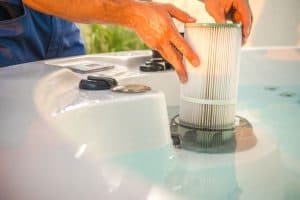
A sensible routine is to inspect the filter regularly and clean it at the intervals recommended by the manufacturer, increasing attention when usage is heavy.
Many owners clean their filters weekly, although the correct frequency depends on the equipment and conditions.
Use the cleaning method recommended for the cartridge.
Some filters can be rinsed and periodically treated with an appropriate cleaning product, while others have different requirements.
Avoid using ordinary household detergents, as residues may create foaming or interfere with water treatment.
A filter cartridge may need replacement if its material becomes damaged, its shape deteriorates or it no longer performs effectively after appropriate cleaning.
Replacement intervals vary by model.
The important distinction is that regular cleaning maintains the filter, while replacement becomes necessary when the cartridge can no longer do its job.
Water treatment is essential, but simple habits can substantially reduce the amount of contamination entering a hot tub.
For example, a hot tub used by two people who shower beforehand may experience a different contaminant load from one used by six people wearing sunscreen and other personal care products.
Both situations require appropriate sanitisation, but reducing contamination at source can make water management easier.
A quick shower helps remove perspiration, body oils, cosmetics and other substances that would otherwise enter the water.
This is particularly useful when several people will be using the spa.
Food particles and spilled drinks can introduce additional contamination.
Keeping refreshments outside the hot tub reduces the likelihood of accidental spills.
A correctly fitted cover helps prevent leaves, insects and airborne debris entering the water.
It can also reduce heat loss, providing a separate benefit for energy consumption.
The cover itself should be kept clean to prevent accumulated dirt entering the water when it is opened or closed.
Leaves, insects and other visible material should be removed promptly with suitable equipment.
This prevents unnecessary material being drawn into the filtration system.
These habits do not eliminate the need for testing or chemical treatment, but they can make routine water care more manageable.
Even with good sanitisation and filtration, hot tub water cannot be maintained indefinitely.
Over time, dissolved substances accumulate from bathers, treatment chemicals and the original fill water.
These substances are not necessarily removed by the filter.
Eventually, water replacement may be required to restore suitable conditions.
For some domestic hot tubs, changing water approximately every three to four months is a useful planning guideline. However, this is not a universal interval.
The correct frequency depends on:
A heavily used hot tub may require more frequent changes than one used occasionally.
Water should also be replaced sooner when testing and appropriate corrective treatment cannot restore suitable conditions.
Water replacement provides an opportunity to inspect and clean areas that are less accessible when the spa is full.
A typical process involves using an appropriate pipework cleaning treatment where recommended, draining the tub, cleaning the shell, maintaining the filters and refilling with suitable water.
The new water then needs balancing and sanitising before use.
Always follow the manufacturer’s drainage, cleaning and start-up instructions.
Do not assume that freshly filled tap water is immediately suitable for bathing.
Cloudiness can develop for several reasons, including inadequate filtration, contamination or unsuitable water chemistry.
The first step should be to stop using the hot tub until the cause has been assessed and the water has been returned to suitable conditions.
Check the relevant water chemistry readings and inspect the filter and circulation system.
Do not assume that cloudy water simply needs an additional dose of sanitiser.
For example, if the filter is heavily clogged, chemical treatment alone will not resolve the underlying filtration problem.
Similarly, if the water contains excessive accumulated dissolved substances, continual adjustment may be less effective than replacing it.
Persistent cloudiness should be investigated rather than repeatedly treated without understanding the cause.
Water that develops unusual discolouration, persistent foaming or an unpleasant smell may also indicate a problem requiring attention.
The important principle is that water quality problems should be assessed using testing and equipment checks rather than appearance alone.
Poor maintenance can affect more than water clarity.
Unbalanced water chemistry may contribute to scale formation or corrosion, depending on the conditions.
Scale can accumulate on surfaces and components, while corrosive water may damage certain materials over time.
Restricted filtration and circulation may also affect the operation of pumps and heaters.
This makes correct water care important for protecting the equipment as well as supporting safe bathing.
For owners who are uncertain about maintenance requirements or experiencing persistent water quality difficulties, professional hot tub maintenance support can help identify problems and establish an appropriate routine.
A consistent schedule makes it easier to keep track of essential tasks.
The following routine provides a useful framework for domestic owners. The manufacturer’s requirements and the water treatment system should always take priority.
This routine should be adjusted according to how frequently the hot tub is used.
For example, a household regularly entertaining guests may need more frequent water testing and additional attention to filtration.
Yes. Water can appear perfectly clear while containing inadequate sanitiser levels or harmful microorganisms. Regular testing and correct treatment are necessary, regardless of appearance.
Some hot tubs use bromine or other manufacturer-approved treatment systems. However, water still requires an effective method of sanitisation. Alternative systems should not be assumed to make chemical treatment or regular testing unnecessary.
A cover helps prevent dirt, insects and debris entering the water, but it does not sanitise the water or remove existing contamination. It should be used alongside filtration, testing and appropriate water treatment.
This depends on the model and its circulation system. Some hot tubs have dedicated circulation pumps designed for continuous operation, while others use programmed filtration cycles. Follow the manufacturer’s recommended settings rather than changing filtration schedules purely to reduce electricity use.
Ordinary household cleaners should not be used unless specifically approved by the manufacturer. Residues may cause foaming, interfere with water chemistry or damage components. Use products designed and approved for the relevant hot tub surfaces and equipment.
Keeping hot tub water clean and clear is primarily about maintaining a routine rather than responding to problems after they become visible.
Regular sanitiser and pH testing helps establish whether the water is suitable for bathing. Filtration removes suspended debris, while appropriate water balance helps protect both bathers and equipment.
Good everyday habits can reduce contamination, and periodic water replacement prevents dissolved substances from accumulating indefinitely.
The most important point is consistency. A few minutes of regular attention can make water management much easier and reduce the likelihood of persistent problems.
Total Hot Tubs supplies domestic hot tubs and provides maintenance and aftercare support. If you need advice about looking after your spa or are experiencing ongoing water quality problems, the team can help you understand the next steps.
Phone: 0800 999 8707
Email: info@totalhottubs.co.uk
Find out more: https://totalhottubs.co.uk/
When it comes to keeping your spa

Thinking about adding a small hot tub
Hot tubs are built for relaxation —

If you’re new to spa ownership or

A failing hot tub pump can produce several warning signs before it stops working completely. Unusual noises, reduced water circulation, intermittent operation, leaks and repeated

Hot tub maintenance costs are an important consideration for anyone planning to buy a spa or already enjoying one at home. Although day-to-day maintenance is

If entertaining friends or family is one of the main reasons you are buying a hot tub, choosing the right size involves more than simply